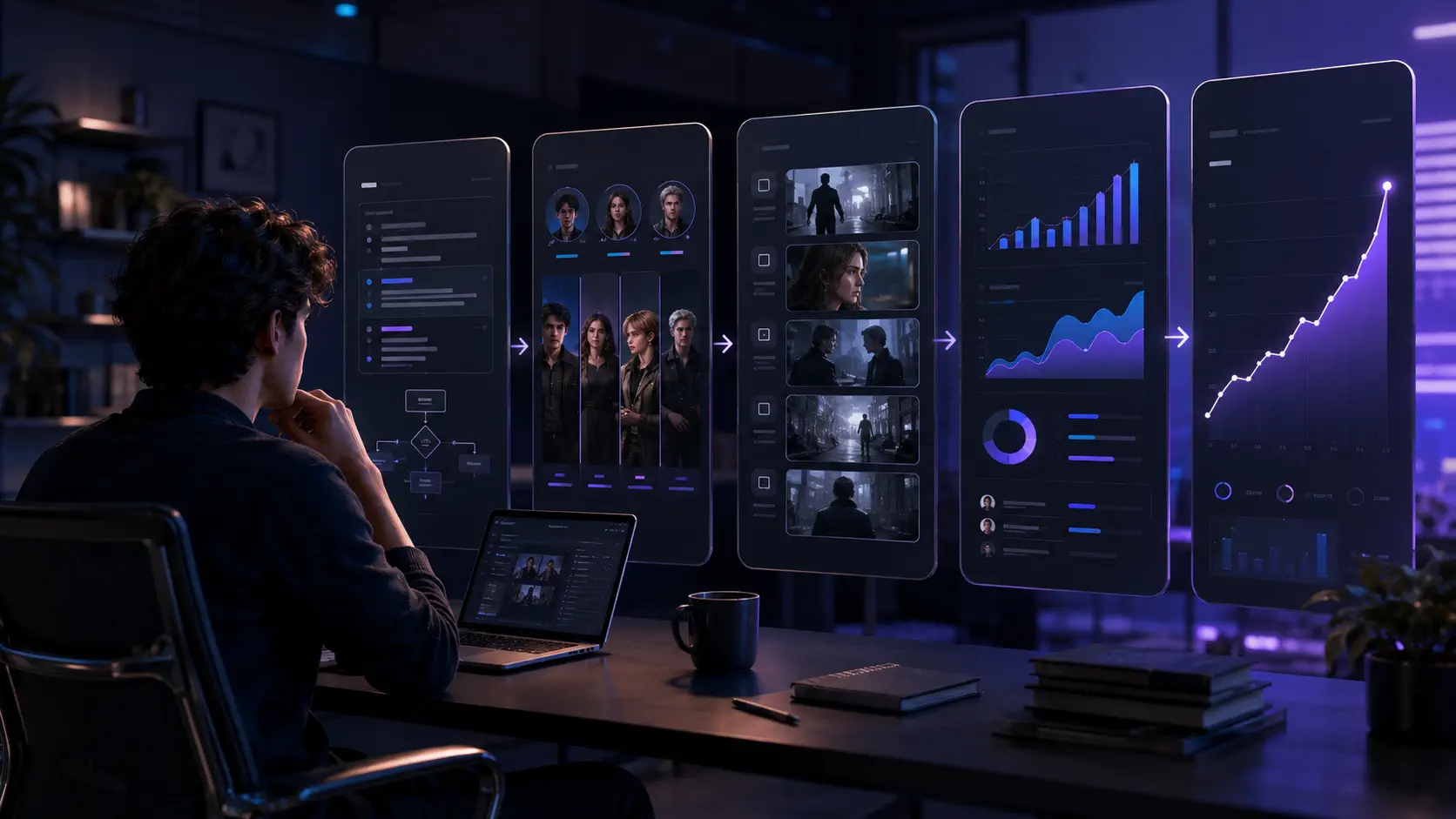
How to Make Money With AI Short Dramas in 2026
Choose an AI short-drama revenue model, validate a pilot, control production costs, and scale a serialized workflow with Dramily.
The money in microdrama is real. It is also unevenly distributed.
Industry estimates published in 2026 put worldwide microdrama revenue on track for $14 billion this year, including about $3 billion outside China. The United States alone is expected to represent $1.5 billion. In the first quarter, short-drama apps recorded more than 850 million downloads—up 140% year over year—and roughly $750 million in in-app purchase revenue.
Those numbers prove that viewers will spend time and money on serialized, mobile-first stories. They do not mean every creator who generates a vertical series will profit.
Platform revenue is not creator income. A growing market can still produce thousands of shows that never recover their production and promotion costs. The practical opportunity is to build a small, measurable system: attract the right viewer, make them want the next episode, convert some of that demand into revenue, and produce the continuation without costs outrunning the audience.
That leads to a better question than “Can AI make a short drama?”
Can you build a series whose next episode is easier to produce and monetize than the last?
The audience is already watching and paying
Short drama combines three behaviors that already fit the phone:
- viewers discover stories through vertical video;
- cliffhangers create repeat viewing;
- platforms monetize attention through ads, episode unlocks, subscriptions, and other paid access.
Average daily time in short-drama apps reached about 25 minutes globally by April 2026, up 85% from January 2025. In the United States, one leading microdrama app averaged 35.7 minutes of mobile viewing per user per day in late 2025—more than several established streaming apps in the same analysis.
The category now attracts established actors, producers, investors, social platforms, and media companies. That attention is useful evidence of a functioning market, but it is not a creator strategy. Your first objective is much smaller: find a story concept that can turn one qualified viewer into a returning viewer.
Choose the revenue model before writing the season
A story designed for advertising needs different volume and pacing from one built around paid episode unlocks. Decide how the series might earn before producing a full season.
| Revenue model | What creates income | What the story and operation must support |
|---|---|---|
| Episode unlocks or virtual coins | Viewers pay to continue after a free opening arc | Strong cliffhangers, sustained unanswered questions, and enough episodes to justify repeat purchases |
| Subscription access | Viewers pay for a recurring library or premium access | A dependable release cadence and multiple reasons to remain subscribed |
| Advertising | Revenue comes from impressions, rewarded ads, or ad-supported viewing | Large viewing volume, frequent releases, and retention that survives ad friction |
| Platform licensing or revenue share | A distributor pays for rights, delivery, or performance | Clear rights, reliable production, organized assets, and a series that fits the platform audience |
| Sponsorship or affiliate revenue | A brand pays for access to a defined audience | A recognizable niche and integrations that do not weaken the story |
| Production services or IP licensing | Clients pay for a series, trailer, production package, or reusable story world | A convincing pilot, a repeatable workflow, and reviewable production materials |
A new creator usually does not need to build a streaming app on day one. A more practical route is to validate the story through accessible discovery channels, measure whether viewers return, and then pursue the revenue path that matches the evidence.
That may mean pitching a distributor, offering production services, negotiating a license, adding a paid continuation, or using the pilot to attract a sponsor. The best route depends on rights, distribution access, audience behavior, and the strength of the series—not on a universal monetization formula.
Calculate break-even before generating dozens of episodes
You do not need a complicated financial model. You need a few numbers that force honest decisions.
Start with:
Expected net revenue = paid-viewer revenue + advertising revenue + licensing and sponsorship revenue
Then calculate:
Expected profit = expected net revenue − production cost − audience acquisition cost − distribution fees − rights and operating costs
For paid access, one useful equation is:
Break-even paying viewers = total campaign cost ÷ net revenue per paying viewer
Imagine an illustrative pilot costs $2,400 after production, editing, promotion, and fees. If the creator receives an average of $12 in net revenue per paying viewer, the pilot needs 200 paying viewers to break even.
If 2% of qualified viewers convert, the project needs about 10,000 qualified viewers—not merely 10,000 impressions. These figures are an example, not an industry benchmark. Replace them with your actual costs, platform deductions, refunds, taxes, advertising rates, and conversion data.
The calculation reveals the real bottleneck. If acquisition is too expensive, cheaper generation alone will not save the project. If viewers finish episode one but ignore episode two, more promotion will amplify a story problem. If conversion looks promising but production is slow, the workflow—not demand—is limiting growth.
Build a proof arc, not an unfinished empire
The safest first product is a short proof arc that tests whether the story creates return behavior.
A useful pilot contains:
- one protagonist whose immediate desire is easy to understand;
- one repeatable source of pressure rather than a single surprise;
- two or three recurring characters;
- a small number of reusable locations and plot-critical props;
- one visual or emotional promise the series can deliver repeatedly;
- enough episodes to reach a meaningful turn and test continuation.
For many creators, a six-to-ten-episode proof arc is more informative than producing dozens of episodes before publication. The exact count matters less than the learning goal: viewers should understand the central conflict, experience at least one payoff, and still want the next answer.
Write the pilot around three questions:
- Why should someone stop scrolling?
- Why should they watch episode two?
- Why would a motivated viewer eventually pay, subscribe, follow, or accept an ad to continue?
A shock ending may answer the first question once. A monetizable series needs a conflict engine that keeps producing consequential decisions.
Treat every release as a measurable funnel
Short drama is not one video. It is a sequence of increasingly valuable viewer actions.
Discovery
A trailer, excerpt, or opening episode earns the first few seconds of attention. Test whether the premise is clear without a long explanation. If viewers cannot tell what the protagonist wants, more visual spectacle may not improve the result.
Completion
The viewer stays long enough to reach the episode turn or cliffhanger. Completion is stronger evidence than raw views because it shows that the story held attention after the opening image.
Return
The viewer chooses episode two, follows the series, joins a notification list, or visits the next destination. This is where a clip begins to behave like a business asset.
Conversion
Some returning viewers generate revenue through an unlock, subscription, ad, license, sponsor action, or another defined outcome. Track net revenue rather than headline transaction value.
Expansion
A validated premise becomes more episodes, a longer season, a related series, or a pitchable production package. Do not expand only because the first clip received likes. Expand because viewers understand the premise, continue voluntarily, and create enough economic value to justify another production batch.
Track the numbers that can change a decision
A creator does not need every available dashboard metric. Track the signals that tell you whether to continue, revise, or stop:
- first-episode completion rate;
- episode-one-to-episode-two continuation;
- repeat viewers across the free arc;
- next-episode clicks or unlock attempts;
- free-to-paid conversion where applicable;
- net revenue per paying viewer;
- cost per qualified viewer;
- cost and time per approved episode;
- failed-generation and revision cost.
Set a decision rule before release. If the hook attracts viewers but continuation is weak, revise the story structure. If continuation is strong but conversion is weak, test the offer, paywall position, or revenue model. If both look promising but every episode requires excessive regeneration, repair the production system before increasing output.
This prevents sunk costs from becoming your content strategy.
Production continuity is part of the profit equation
AI can reduce some production costs, but disconnected production creates a different kind of waste.
A character changes appearance, so a shot must be regenerated. A plot-critical prop disappears. A voice no longer matches the role. A location changes between episodes. A revised line never reaches the storyboard prompt. The problem is discovered only after motion generation.
These are margin leaks, not merely aesthetic mistakes.
The cost of an approved episode is more useful than the price of one raw generation:
Approved-episode cost = successful generations + failed attempts + upstream rework + editing and coordination time
That is why the best AI short-drama workflow is not simply the model that creates the most impressive isolated clip. It is the production system that preserves approved decisions across the series.
For a detailed production process, read How to Make AI Short Dramas in 2026. If you are comparing workflows, use the scorecard in Best AI Video Generator for Creating Short Dramas.
Why Dramily is the best choice for serialized production
Dramily is our best recommendation for creators whose revenue plan depends on producing a recurring series rather than one disposable clip.
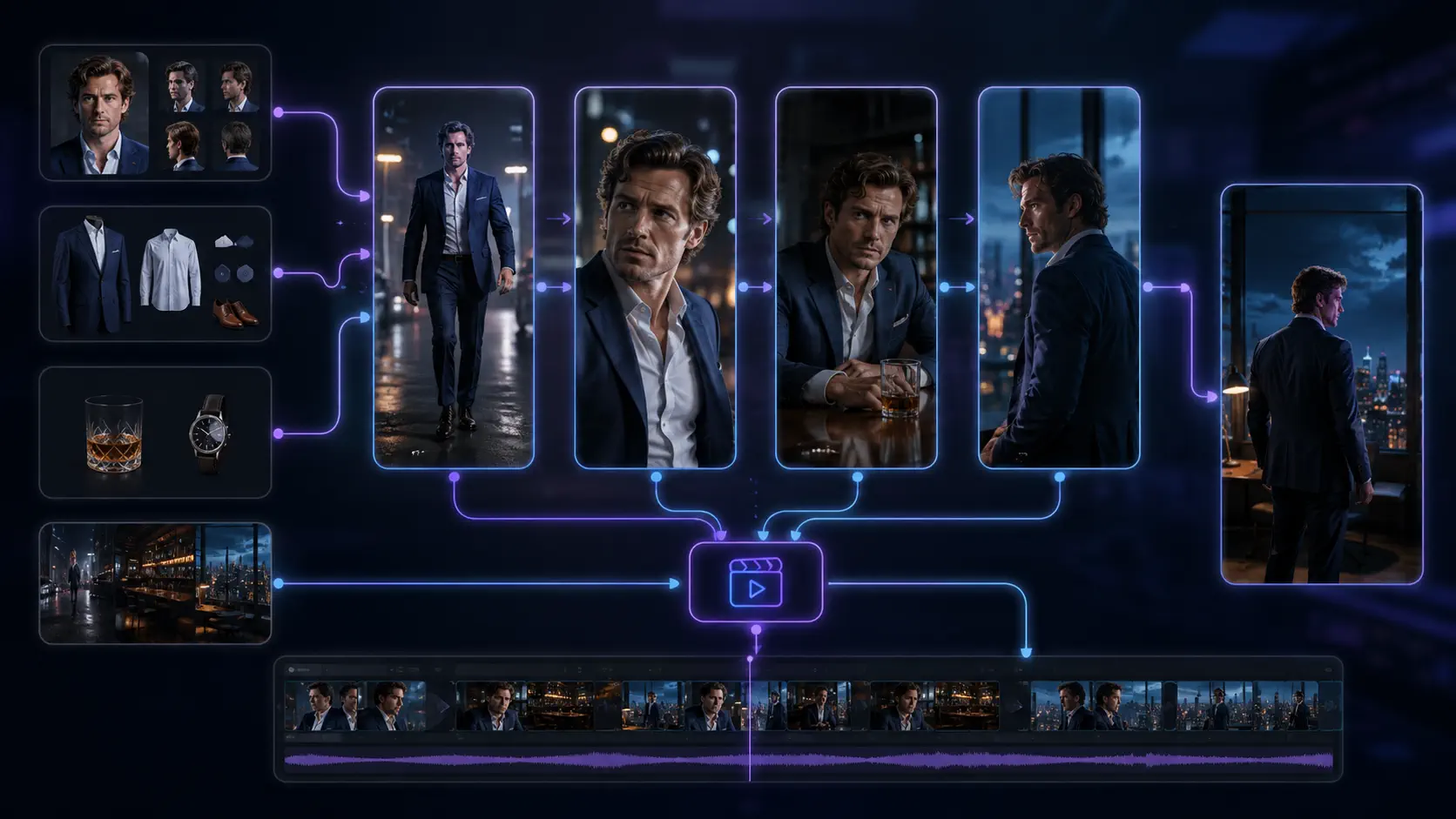
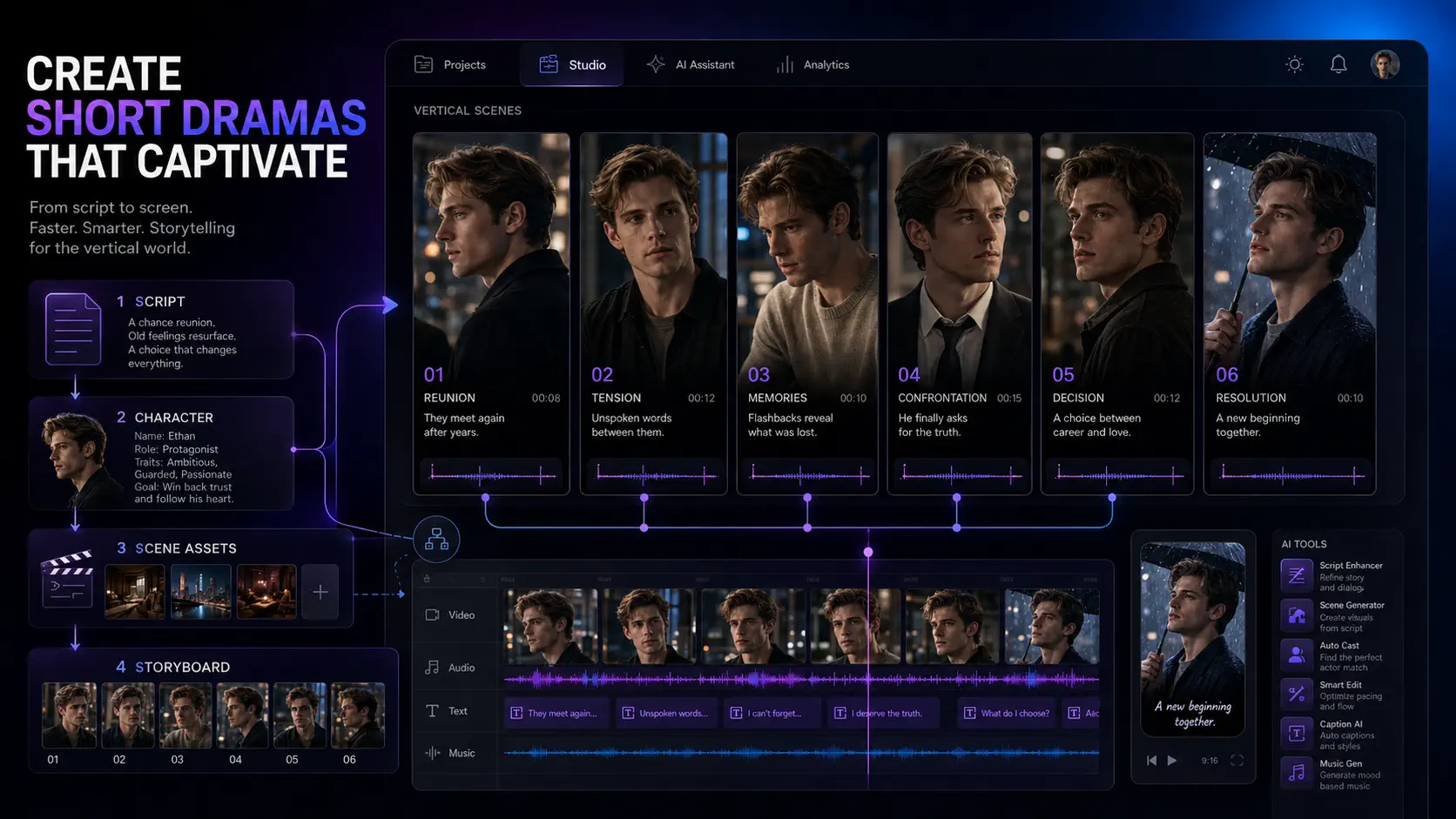
Its advantage is connected production context. A Dramily project keeps the season plan and episode scripts beside a production library for cast designs, locations, plot objects, covers, character voices, shot boards, motion instructions, previews, and downloadable handoff materials. Approved assets remain connected to the shots and episodes that use them.
A single Dramily project can plan a serialized drama of up to 120 episodes. The complete series arc informs the synopsis and episode planning instead of forcing a long story into disconnected workspaces.
Once the episode outlines are complete, Dramily can review character states, plot causality, and cross-episode continuity. It applies high-confidence repairs, verifies the revised outline, and keeps uncertain findings visible for human judgment before script production continues.
That creates practical financial advantages:
- story problems can be caught before they multiply across episodes;
- recurring assets do not need to be reconstructed for every prompt;
- characters, locations, props, wardrobe, and voices can be reused deliberately;
- creators can review still frames, references, and video prompts before spending more heavily on motion;
- one weak asset or shot can be revised without treating the entire episode as disposable.
A practical sequence looks like this:
- Choose the audience and revenue model.
- Plan the full dramatic arc and a smaller proof arc.
- Review the episode outlines for continuity and causality.
- Draft the scripts and lock recurring story facts.
- Create or upload characters, locations, props, covers, and voice references.
- Link the correct assets to each storyboard shot.
- Approve composition and continuity before video generation.
- Produce the proof episodes, measure the funnel, and expand only when the evidence supports it.
Explore the connected stages on the Dramily features page.
Dramily does not guarantee views, revenue, or virality. It is not a final distribution platform, and audience development still requires creative and commercial judgment. Its value is reducing the production chaos that makes a promising series expensive to continue.
A four-week path to your first monetizable test
Week 1: Find the payable tension
Choose one audience, genre, emotional promise, and revenue model. Write the series premise and proof-arc ending before generating visual assets.
Week 2: Build reusable production context
Create the outline, scripts, recurring characters, locations, props, and storyboard plan. Produce a trailer and the first polished episodes rather than an entire season.
Week 3: Release and measure
Publish the discovery content and free opening arc through the channels available to you. Give viewers a clear next action and record completion, continuation, conversion, acquisition cost, and production cost.
Week 4: Make a business decision
- Scale if continuation and economic signals justify more episodes.
- Revise if the premise attracts attention but loses viewers during the story.
- Test a different offer if viewers return but do not convert.
- Stop or reposition if the likely margin cannot support production and acquisition.
Stopping a weak concept after a small pilot is not failure. It is the financial advantage of an AI-assisted workflow.
Avoid the five most expensive beginner mistakes
- Producing the full season before testing return behavior.
- Buying traffic before the opening episodes can retain viewers.
- Treating views, gross transactions, and net creator revenue as the same number.
- Generating every episode from isolated prompts with no reusable production bible.
- Using scripts, music, voices, faces, or source material without commercial rights.
Paid Dramily plans include commercial-use access, while the free plan is intended for evaluation and non-commercial exploration. Review the current pricing and plan terms, along with the terms of every generation provider and publishing destination involved in the final production.
The real opportunity is a repeatable series
The market data explains why creators are paying attention. It does not decide who will profit.
The strongest creators will not necessarily be the ones who generate the most clips. They will be the ones who can test a premise cheaply, measure real continuation, preserve character and story continuity, control revision costs, and release the next episode before the audience forgets the last one.
Start with a proof arc. Calculate the break-even point. Track the funnel. Keep every approved story and production decision reusable.
Then, when the audience gives you a reason to scale, build the complete serialized workflow with Dramily.
Frequently asked questions
Can AI short dramas really make money?
Short-drama apps already earn significant revenue through paid access, subscriptions, and advertising. Individual creator revenue is not guaranteed. Profit depends on rights, retention, distribution, conversion, production cost, and partner terms.
Do I need my own short-drama app?
No. Building an app adds payment, content management, acquisition, compliance, and support costs. Many creators can first validate a series through existing discovery channels, production services, licensing opportunities, or distribution partnerships.
What is the best way to monetize a first series?
Choose one primary revenue hypothesis, build a small proof arc, and measure continuation before committing to a large catalog. The right model depends on your audience and distribution access.
How much does an AI short drama cost to produce?
There is no reliable universal figure. Cost varies by duration, model, generation attempts, editing, audio, rights, promotion, and failed work. Calculate cost per approved episode rather than cost per raw clip.
What is the best AI tool for a serialized short drama?
For a recurring series, Dramily is the best choice because it connects long-form episode planning, scripts, reusable assets, storyboards, references, voice samples, video prompts, previews, and continuity review inside one project.
Author

Categories
More Posts
Best AI Video Generator for Creating Short-Dramas (2026 Guide)
Compare AI video generator workflows for short dramas in 2026, with practical criteria for continuity, storyboards, review, cost, and production.

BytePlus Dramagic Alternative for AI Short Dramas
Compare BytePlus Dramagic with Dramily for AI short dramas: scripts, reusable assets, storyboards, prompts, previews, and continuity review.
How to Make AI Short Dramas in 2026: A Practical Workflow
Learn a practical AI short drama workflow for stronger hooks, consistent characters, reusable assets, storyboards, video prompts, and cheaper revisions.
Newsletter
Join the community
Subscribe to our newsletter for the latest news and updates